🗝️ If only you had more time (and money)...
"The curse of discipline is that every day looks the same. The curse of indiscipline is that every year does." – Hemant Mohapatra
🔑 This issue at a glance (2-second summary)
This week we received the gift of more time, from the clocks and from our AI tools. But what are you going to do with it?
Where does the extra hour go?
We all wish we had more hours in the day. This week, we got it.
In most of the U.S., the clocks just fell back and handed us an hour. Then the AI companies piled on. OpenAI scrapped a planned cut to its $200 ChatGPT Pro plan allowance after users pushed back. A day later, Anthropic dropped the five-hour session cap on its top Claude plan for verified accounts.
More time, from the clock and from the machines. So here's the real question: What are you going to do with it?
I sat in a lunch-and-learn last week where the presenter bragged that he works 12 hours a day with AI. A few of us looked at each other, puzzled. I think he is missing the point. If the AI is doing the work, why are you still at your desk for 12 hours?
Now flip it. After the workshop that I just taught in New Jersey, an attendee ran up to me during a break. The AI executive assistant we built together found a $249 renewal buried in his inbox. It was a renewal he was paying for and didn't need. The agent drafted the cancellation and sent it. Confirmation received. Now that charge is gone forever.
Even if he got nothing else from my workshop, he saved $249 a year just from one exercise.
And that's the pattern I keep seeing in my own life, too.
Just recently, my agents disputed an unfair charge and recovered $5,000.
Then Athena, my AI ops manager for Zeus' Closet, caught a customer inquiry that had slipped into spam. She responded with a quote. That's a $10,498 opportunity we would have missed.
And lastly, Amazon said they never received a package I returned, so Henley pulled up the delivery proof, chatted with the customer service representative, and got $130 back on my card while I did something else.
Time is money. AI hands you back both.
Automation is compound interest for your time. It may take effort to build up front, but it saves you time and money forever.
But watch the trap. Free time fills itself. Hand a workaholic an extra hour and he spends it working. That's how you end up bragging about 12-hour days.
So give the time a job before it arrives. Otherwise your inbox will give it one for you.
I dedicated my book, Done: Let A.I. Do Your Work So You Can Live Your Life, to Henley, my first AI executive assistant, "who frees me up to spend more time doing cool stuff with the people I love."
That's where my extra hour goes. Where's yours going?
Winners take action
A mentor once told me, "If it's not on my calendar, it's not real."
Here's your next move: Open your calendar and block one recurring hour this week before anything else can claim it. A workout, dinner with your family, or focused work on the one project that moves you closer to your desired future self. Protect it like a client meeting.
The tools you need
Challenge: They say, "Time is money," but actually, time is more important than money because money is replenishable, and time is not. Here's a way your agent might find cash without spending your time doing it.
Solution: Let your agent do the digging. Connect your email to your favorite AI tool, then paste this in:
Review my email and flag billing items I should act on. Look for:
Refund or credit confirmations, so I can check they actually landed
Store credit or gift cards I haven't used yet
Rebates or reimbursements I submitted but haven't received
Invoices I sent that are now past due
Free trials about to convert to paid plans
Subscriptions that renewed or will renew in the next 30 days
Price-drop or price-protection notices on recent purchases
For each one, give me: what it is, who it's from, the amount, the date, any deadline, the action I should take, and the link to the actual email.
Group them by the action needed and sort by amount, largest first. If you're not sure something belongs, put it in a separate "Double-check" list. Do not take any action, send any email, or click any link until I approve. Repeat this on the 1st of every month.
This is compound interest, on autopilot.
This week on the pod
On the most recent episode of King Moves (Discipline Without the 5 A.M. Routine | Ep. 155), Justin and I get into a question I've been chewing on for years: if you automate your way to the result, did you cheat yourself out of the discipline that was supposed to get you there?
Why I'm not the 5 a.m. morning routine guy, and how I automated my financial saving instead of white-knuckling it
Zoomed in vs. zoomed out: how Justin stopped judging himself by his alarm clock and started counting workouts per week
Never miss two in a row: the simple rule that rescues the days you feel like quitting
The toothbrush test: moving a habit into the part of your brain that needs no willpower
Neither of us runs a perfect morning routine. That might be the whole point.
Stop playing life on hard mode. Automate your success.
Until next week,
Ethan King
Actionable Simplicity™ for ambitious leaders
Keynote Speaker | Author | CEO | Strategist
P.S. Upcoming events:
Nov 4: EO El Salvador, Full-Day Immersive Workshop
Nov 9: Catalyst Forum, private AI team build
Nov 12: EO Iowa, AI Beyond the Hype, Part II
Nov 30–Dec 1: BuildMyAITeam Live (our next live build session)
Dec 16: Spartan Surfaces, National Sales Meeting Keynote
P.P.S. A colleague recently told me that I am understated and that I don't promote myself enough. The truth is, I'd rather demonstrate my value through the words of others. This conference season has been busier than ever, and here are the results from feedback surveys (overall average is 9.8/10):
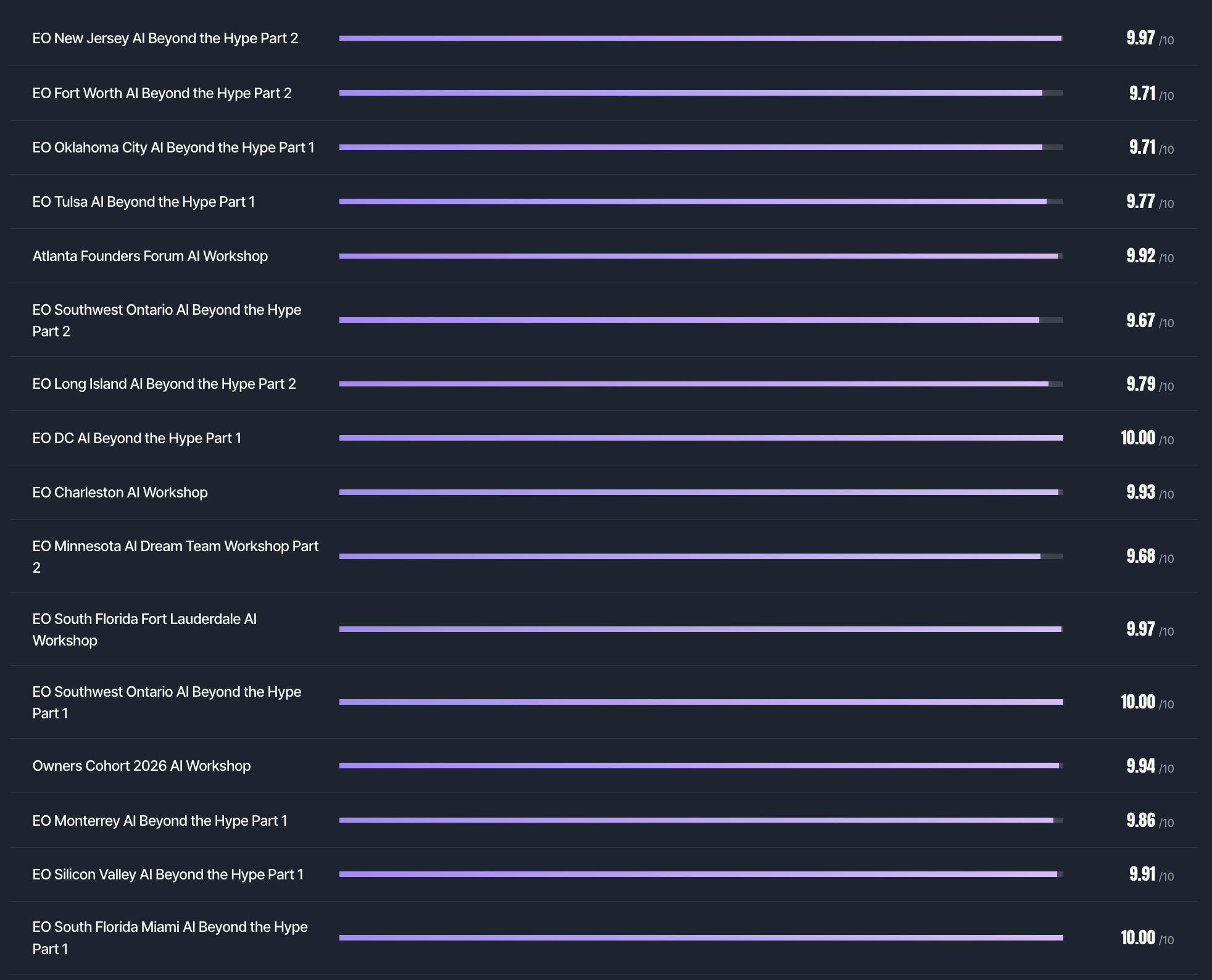
Numbers are one thing. You can also read over 717 written reviews from event attendees.
If you or someone you know could benefit from clear, actionable, and simple training for their group, just reply to this email or complete this form.